What is it?
The reversal is a reversal of direction in the vertical: pull up, roll inverted and come out the other way. Unlike the J-hook you do not fly away first.
When do I use it?
Defensive, when someone is behind you and you have no room for a J-hook. Also as the end of a turning fight in which neither is getting anywhere.
What do I want to achieve?
You want to break up the pursuit and get into the attack yourself – without giving away separation and without showing your tail.
Starting position
The opponent is behind you, you still have speed, and there is room above or below you.
Step by step
- Check your speed. Without speed the reversal becomes a rotation on the spot – and you stop.
- Briefly straight. A reversal out of a turn comes out flat; out of straight flight it comes out tight.
- Pull up. Steeply, in the strong axis.
- Roll. Roll over the top so the nose falls into the opposite direction.
- Come out and search. Lock the attacker again. He is now in front of you – or, in the bad case, still right behind you.
- Decide. Attack run or the next defensive manoeuvre.
Keyboard and mouse
Pulling up is the mouse, rolling the two roll keys. The reversal is one of the few movements where you need both at once and in the right order – practise slowly, then fly fast.
Pulling up and rolling are the core. Plus throttle, because a reversal without speed does not work, and attacker cycling to find him again.
| Game action | Default keyboard/mouse | Default joystick | Trigger |
|---|---|---|---|
| Pitch | not bound by default | Axis Y | axis |
| Pitch up | Arrow down | not bound by default | single press |
| Pitch down | Arrow up | not bound by default | single press |
| Yaw | not bound by default | Axis X | axis |
| Yaw left | Arrow left | not bound by default | single press |
| Yaw right | Arrow right | not bound by default | single press |
| Roll | not bound by default | Axis Rz (twist) | axis |
| Roll left | Q | not bound by default | single press |
| Roll right | E | not bound by default | single press |
| Throttle - Increase | W | not bound by default | single press |
| Throttle - Decrease | S | not bound by default | single press |
| Boost | Left Shift | Button 8 | hold |
| Spacebrake | X | not bound by default | single press |
| Cycle Lock - Attackers - Forward | 4 | not bound by default | single press |
Game default binding, game version 4.10.0-hotfix (55227). If you rebound it yourself, your binding applies.
Anything marked “not bound by default” you have to bind yourself in the game settings – we do not guess a key.
HOTAS/HOSAS: the joystick column is the default binding of ONE stick. On two sticks you assign pitch, yaw, roll and lateral strafe yourself – which axis a manoeuvre needs is listed in the HOTAS / HOSAS section.
HOTAS / HOSAS
A manoeuvre does not need particular keys, it needs particular axes and functions. If you fly HOTAS or HOSAS you assign them once and then only read which of them a manoeuvre asks for:
- Pitch, yaw, roll – the three rotation axes. By default on one stick they sit on X, Y and the twist axis Rz.
- Strafe X/Y/Z – sideways, up/down, forward/back. By default these are single buttons and a hat, not axes; on HOSAS you put them on the second stick’s axes.
- Throttle – the throttle lever or the forward/back function.
- Boost, space brake, decoupled mode – three buttons you must hit blind in a fight.
- Targeting – at least “lock target under reticle” on a thumb button.
Which of these are bound by default is in the table above. Everything marked “not bound by default” you assign yourself.
You need pitch and roll in one flowing movement and a throttle you do not have to touch while doing it. On HOTAS the reversal is one of the manoeuvres that feel more natural with a stick than with a mouse.
Speed and energy
The reversal eats speed – unavoidably, you are reversing your direction of movement. Plan it while you still have speed, not once you are already slow. Boost on the exit brings you back into the fight.
Movement diagram
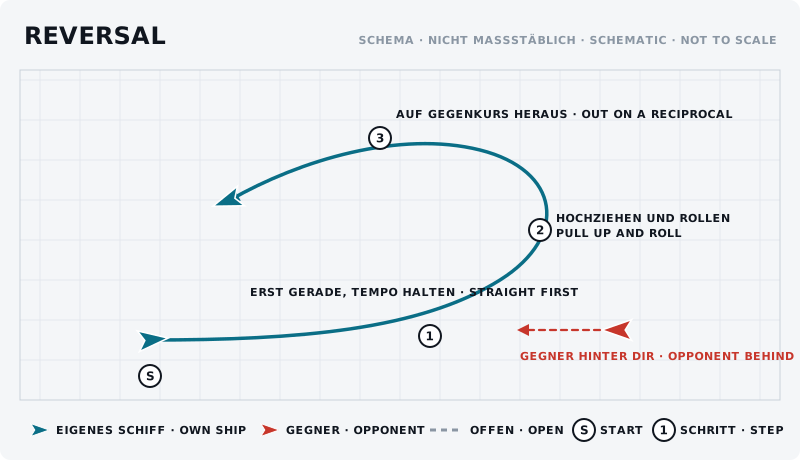
The sketch shows the manoeuvre from above: own ship blue, opponent red, start marked “S”, steps numbered.
What should the opponent see?
He sees you pull up. An inexperienced pursuer follows and loses more speed than you – then he is up top and you are below. An experienced one stays low and waits for you to come out.
Typical mistakes
- Too slow. The most common mistake: a reversal with too little speed ends in a standstill.
- Out of a turn. Comes out flat and predictable.
- Not rolling. Without the roll you come out on top and keep flying the same way.
- Not searching afterwards. If you do not find the attacker again immediately you have only swapped directions.
Opponent’s counter
He does not follow but stays low and waits with speed for your exit – then you come out slow in front of his guns.
Exercise
- Goal
- Come out on a reciprocal course from being chased without losing your bearings.
- Preparation
- A partner follows at constant distance without shooting.
- Task
- Ten runs. Fly straight, then pull up, roll and come out on a reciprocal course. The partner reports whether he lost sight of you and whether he came out in front of or behind you.
- Success criterion
- You come out with your nose in his direction and have him in sight again immediately.
- Partner
- required
- Functions needed
- Pitch
- Pitch up
- Pitch down
- Yaw
- Yaw left
- Yaw right
Beginner variant
Fly the reversal without a pursuer until pulling up and rolling are one flowing movement.
Advanced variant
Reversal out of a turning fight: once out of a rate fight, once out of a defensive spiral. Compare which exit costs more speed.
Next step
If he is too fast during your reversal he overshoots – and then overshoot applies.