What is it?
When shooting at a moving target the game shows a predicted aiming point – the pip. It is computed from your current movement and the projectile speed. Pip manipulation means changing that movement so the computation no longer holds.
When do I use it?
Defensive, whenever someone behind you is shooting. Useful offensively too: whoever knows how the pip is made also understands why his own shot misses.
What do I want to achieve?
You want every shot to go where you will no longer be. Not dodging – invalidating the prediction.
Starting position
Someone is behind you with a firing solution. Your shields are still holding.
Step by step
- Change movement, not heading. Lateral strafe changes the path immediately without swinging the nose.
- Irregularly. Not on a beat. Sometimes one second, sometimes three; sometimes up, sometimes sideways.
- Stop as well. Suddenly stopping the lateral movement shifts the pip just as much as starting it.
- Add throttle. Braking and accelerating change the computation too.
- Do not throw the nose around. Swinging only the nose barely changes the path – and you stop hitting anything yourself.
Keyboard and mouse
On the keyboard this is a game with four keys. Important: short, irregular taps instead of holding – holding produces a new even path that is predictable again.
You need everything that changes your movement without throwing the nose off: the four strafe directions, throttle and brake.
| Game action | Default keyboard/mouse | Default joystick | Trigger |
|---|---|---|---|
| Strafe up (abs.) | Space | Button 9 | single press |
| Strafe down (abs.) | Left Ctrl | Button 10 | single press |
| Strafe left (abs.) | A | Hat 1 left | single press |
| Strafe right (abs.) | D | Hat 1 right | single press |
| Throttle - Increase | W | not bound by default | single press |
| Throttle - Decrease | S | not bound by default | single press |
| Boost | Left Shift | Button 8 | hold |
| Spacebrake | X | not bound by default | single press |
| Cycle Lock - Attackers - Forward | 4 | not bound by default | single press |
Game default binding, game version 4.10.0-hotfix (55227). If you rebound it yourself, your binding applies.
HOTAS/HOSAS: the joystick column is the default binding of ONE stick. On two sticks you assign pitch, yaw, roll and lateral strafe yourself – which axis a manoeuvre needs is listed in the HOTAS / HOSAS section.
HOTAS / HOSAS
A manoeuvre does not need particular keys, it needs particular axes and functions. If you fly HOTAS or HOSAS you assign them once and then only read which of them a manoeuvre asks for:
- Pitch, yaw, roll – the three rotation axes. By default on one stick they sit on X, Y and the twist axis Rz.
- Strafe X/Y/Z – sideways, up/down, forward/back. By default these are single buttons and a hat, not axes; on HOSAS you put them on the second stick’s axes.
- Throttle – the throttle lever or the forward/back function.
- Boost, space brake, decoupled mode – three buttons you must hit blind in a fight.
- Targeting – at least “lock target under reticle” on a thumb button.
Which of these are bound by default is in the table above. Everything marked “not bound by default” you assign yourself.
This is where strafe axes show their advantage most clearly: on an axis you can vary lateral movement steplessly and irregularly; with keys there is only on and off.
Speed and energy
Strafing costs thrust but barely any forward speed. Constant braking and accelerating costs more. If your ship slows down the prediction gets easy again – keeping speed is part of pip manipulation.
Movement diagram
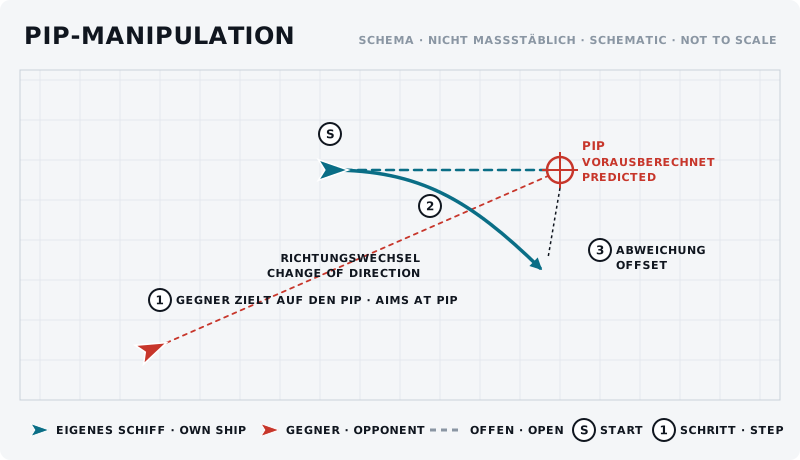
The sketch shows the manoeuvre from above: own ship blue, opponent red, start marked “S”, steps numbered.
What should the opponent see?
He sees an aiming point that jumps. The more irregular your movement, the more he shoots on spec. That is exactly when it pays for him to switch to fixed guns or short bursts.
Typical mistakes
- Strafing on a beat. Left-right-left every second is as predictable as straight flight.
- Only swinging the nose. Does not change the path and costs you your own firing solution.
- Strafing continuously in one direction. That is just another straight line.
- Getting too slow. A slow target is easy to hit even without a pip.
Opponent’s counter
He closes in – the shorter the distance, the smaller the prediction error. Or he switches to fixed guns and aims by hand where he expects you instead of following the pip.
Exercise
- Goal
- Make a partner’s aiming point run into nothing without giving up your own heading entirely.
- Preparation
- A partner follows at a fixed distance, aims but does not shoot – he only reports when his aiming point sat cleanly on you.
- Task
- Fly for 60 seconds and change your lateral movement irregularly every one to three seconds: strafe, stop, change direction, change throttle. The partner counts his clean moments. Then do the same with an even rhythm – and compare.
- Success criterion
- The partner has clearly fewer clean moments with irregular movement than with an even rhythm.
- Partner
- required
- Functions needed
- Strafe up (abs.)
- Strafe down (abs.)
- Strafe left (abs.)
- Strafe right (abs.)
- Throttle - Increase
- Throttle - Decrease
Beginner variant
Have a partner follow you without shooting and just try out how much his aiming point shifts with which movement.
Advanced variant
Pip manipulation inside a turning fight: strafe irregularly while flying a rate fight without losing angle.
Next step
The same idea in its purest form is the defensive spiral. If you want to hit yourself, strafing helps.