What is it?
An overshoot is when the pursuer is faster than the pursued and therefore flies past him. Afterwards the roles are swapped: the one who overshot is in front, the pursued behind.
When do I use it?
Defensive: when someone behind you is faster. Offensive: whenever you are behind someone and faster – then you have to avoid it.
What do I want to achieve?
As the pursued you want to use his speed against him. As the pursuer you want to avoid the simplest trap in a turning fight.
Starting position
A close pursuit. The pursuer has more speed than the pursued.
Step by step
Forcing it (you are being chased):
- Wait until he is close enough – too early and he corrects calmly.
- Take speed off: throttle back or space brake.
- Hold the nose or decouple so you have him in the reticle as he slides past.
- Once he is past: swing in behind him and throttle back up.
Avoiding it (you are chasing):
- Watch the distance. If it shrinks fast without you accelerating, he is braking.
- Take speed off in time – rather too early than too late.
- Go into the lag curve (see pursuit curves); it passes outside him instead of over him.
- If it happens anyway: do not fly on straight, break away across immediately.
Keyboard and mouse
The space brake is the most important key here on both sides. If you only know it as an emergency brake you give away half the manoeuvre.
The same tools on both sides: space brake and throttle to change speed, strafing and decoupled mode to keep the nose on target while doing it.
| Game action | Default keyboard/mouse | Default joystick | Trigger |
|---|---|---|---|
| Throttle - Increase | W | not bound by default | single press |
| Throttle - Decrease | S | not bound by default | single press |
| Boost | Left Shift | Button 8 | hold |
| Spacebrake | X | not bound by default | single press |
| Strafe up (abs.) | Space | Button 9 | single press |
| Strafe down (abs.) | Left Ctrl | Button 10 | single press |
| Strafe left (abs.) | A | Hat 1 left | single press |
| Strafe right (abs.) | D | Hat 1 right | single press |
| Enable / Disable decoupled mode | C | not bound by default | toggle |
| Cycle Lock - Attackers - Forward | 4 | not bound by default | single press |
Game default binding, game version 4.10.0-hotfix (55227). If you rebound it yourself, your binding applies.
HOTAS/HOSAS: the joystick column is the default binding of ONE stick. On two sticks you assign pitch, yaw, roll and lateral strafe yourself – which axis a manoeuvre needs is listed in the HOTAS / HOSAS section.
HOTAS / HOSAS
A manoeuvre does not need particular keys, it needs particular axes and functions. If you fly HOTAS or HOSAS you assign them once and then only read which of them a manoeuvre asks for:
- Pitch, yaw, roll – the three rotation axes. By default on one stick they sit on X, Y and the twist axis Rz.
- Strafe X/Y/Z – sideways, up/down, forward/back. By default these are single buttons and a hat, not axes; on HOSAS you put them on the second stick’s axes.
- Throttle – the throttle lever or the forward/back function.
- Boost, space brake, decoupled mode – three buttons you must hit blind in a fight.
- Targeting – at least “lock target under reticle” on a thumb button.
Which of these are bound by default is in the table above. Everything marked “not bound by default” you assign yourself.
You need throttle, space brake and decoupled mode – all three reachable blind. With strafe axes you can also move sideways while braking so he does not take you with him as he passes.
Speed and energy
The overshoot is an energy trade: you give up your speed to use his against him. Afterwards you are slow – in a fight with several opponents that is dangerous. Only force it when you can actually attack him afterwards.
Movement diagram
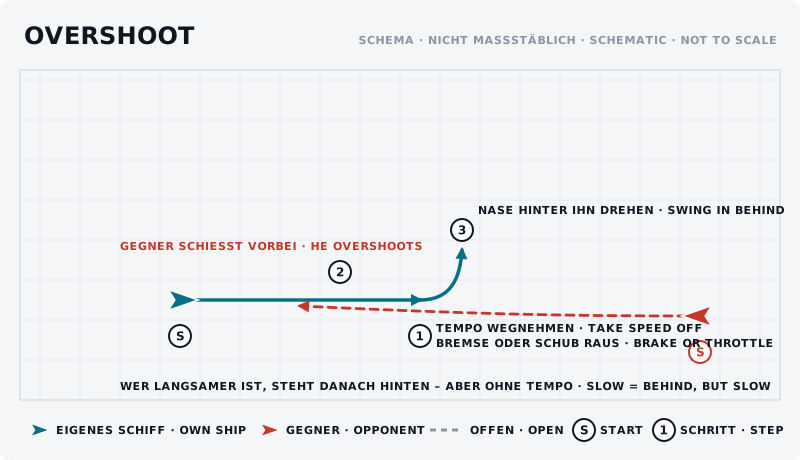
The sketch shows the manoeuvre from above: own ship blue, opponent red, start marked “S”, steps numbered.
What should the opponent see?
As the pursuer you see the overshoot coming from one thing: the distance shrinks without you having got faster. If you only watch the reticle you notice too late.
Typical mistakes
- Braking too early. He has time to correct and ends up even better placed.
- Braking to a standstill. After that you are a stationary target.
- As the pursuer, only watching the reticle. The distance is the warning.
- Flying on straight after the overshoot. Then you hand the position back.
Opponent’s counter
He recognises the braking and goes into the lag curve himself – then he passes outside you instead of over you and stays behind you.
Exercise
- Goal
- Know both roles: force an overshoot and avoid one.
- Preparation
- Two pilots, agreed beforehand, one chases. Open space.
- Task
- Ten runs. In the first five the pursued brakes on call – the pursuer tries not to shoot past. In the second five he brakes without calling. Note how often the pursuer goes past and how he noticed.
- Success criterion
- As the pursued you force the overshoot at least once without calling it; as the pursuer you spot it in time at least once.
- Partner
- required
- Functions needed
- Throttle - Increase
- Throttle - Decrease
- Boost
- Spacebrake
- Strafe up (abs.)
- Strafe down (abs.)
Beginner variant
Practise only the pursuer part: fly behind a partner who brakes on call and take speed off in time yourself.
Advanced variant
Overshoot without calling, using decoupled mode: brake, keep the nose, shoot as he slides past.
Next step
Once you handle the overshoot from both sides you are ready for combinations – manoeuvres made of several of these building blocks.