What is it?
Missile evasion is the reaction to an incoming missile: fly across its approach line and release countermeasures. There are two kinds in the game – decoys and noise – and they sit on two different functions.
When do I use it?
Defensive, immediately. As soon as the warning comes. There is no time to think here.
What do I want to achieve?
You want to use the window in which the missile still has to correct. The more you are across its line, the more it has to turn – and the more likely it loses you.
Starting position
Warning in the cockpit, the missile is on its way. You still have thrust and countermeasures on board.
Step by step
- Find the direction. Where is it coming from? Locking the attacker helps to find the bearing.
- Get across. Do not flee in a straight line – bank across the approach line.
- Release countermeasures. Decoys in a burst, during the lateral movement, not before it.
- Keep changing the path. After the burst keep changing direction so it does not re-acquire you.
- Resume the fight. Do not fall into flight – after the run the shooter is usually still there.
Keyboard and mouse
Decoys and noise are bound by default to two separate keys within reach of the left hand. Set the burst size before the fight, not during the run-in.
Two kinds of countermeasures, plus everything that changes your path quickly. The decoy burst size can be adjusted.
| Game action | Default keyboard/mouse | Default joystick | Trigger |
|---|---|---|---|
| Decoy - Launch Burst (tap), Set and Launch Burst (hold) | H | Button 3 | hold |
| Noise - Deploy (Tap) | J | Button 5 | single press |
| Decoy - Increase Burst Size (tap) | Right Alt + H | not bound by default | single press |
| Decoy - Decrease Burst Size (tap) | Left Alt + H | not bound by default | single press |
| Pitch | not bound by default | Axis Y | axis |
| Pitch up | Arrow down | not bound by default | single press |
| Throttle - Increase | W | not bound by default | single press |
| Throttle - Decrease | S | not bound by default | single press |
| Boost | Left Shift | Button 8 | hold |
| Spacebrake | X | not bound by default | single press |
| Cycle Lock - Attackers - Forward | 4 | not bound by default | single press |
Game default binding, game version 4.10.0-hotfix (55227). If you rebound it yourself, your binding applies.
Anything marked “not bound by default” you have to bind yourself in the game settings – we do not guess a key.
HOTAS/HOSAS: the joystick column is the default binding of ONE stick. On two sticks you assign pitch, yaw, roll and lateral strafe yourself – which axis a manoeuvre needs is listed in the HOTAS / HOSAS section.
HOTAS / HOSAS
A manoeuvre does not need particular keys, it needs particular axes and functions. If you fly HOTAS or HOSAS you assign them once and then only read which of them a manoeuvre asks for:
- Pitch, yaw, roll – the three rotation axes. By default on one stick they sit on X, Y and the twist axis Rz.
- Strafe X/Y/Z – sideways, up/down, forward/back. By default these are single buttons and a hat, not axes; on HOSAS you put them on the second stick’s axes.
- Throttle – the throttle lever or the forward/back function.
- Boost, space brake, decoupled mode – three buttons you must hit blind in a fight.
- Targeting – at least “lock target under reticle” on a thumb button.
Which of these are bound by default is in the table above. Everything marked “not bound by default” you assign yourself.
You need two buttons for decoys and noise – both reachable blind – plus pitch/roll and throttle. By default decoys and noise sit on joystick buttons; check the table for which ones.
Speed and energy
Boost helps to get out of the approach cone but also makes you brighter and easier to predict. A lateral movement without boost usually beats a run with boost.
Movement diagram
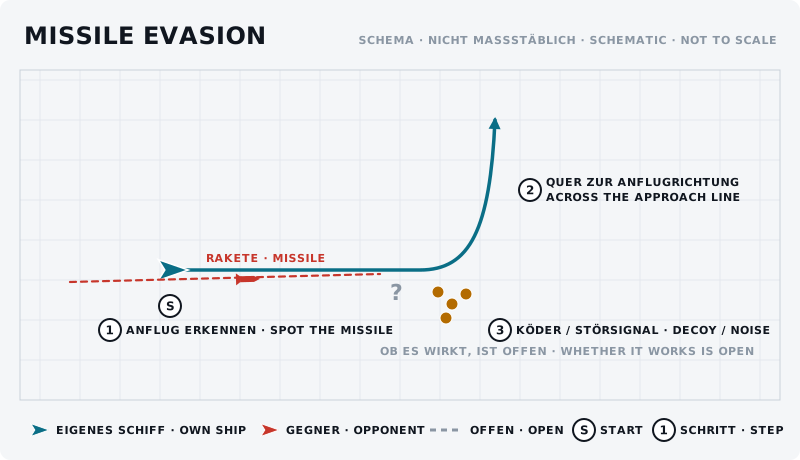
The sketch shows the manoeuvre from above: own ship blue, opponent red, start marked “S”, steps numbered.
What should the opponent see?
He sees whether you react. Anyone who does nothing after the first warning gets the second missile. Anyone who does the same thing every time gets it from the other direction.
Typical mistakes
- Fleeing straight ahead. The easiest task you can set a missile.
- Decoys first, movement later. The burst does little if you are still on the old path.
- All countermeasures at once. Afterwards you have none, and the fight is not over.
- Continuing to flee after evading. The shooter is still there and now has a clear run.
Opponent’s counter
He fires two missiles in quick succession so the first pulls your countermeasures. Or he waits until you start the lateral movement and puts the missile into your new direction.
Exercise
- Goal
- Be able to run the sequence warning – across – countermeasure without thinking.
- Preparation
- A partner with missiles, agreed beforehand, in open space. Practise without fire first, then with.
- Task
- Ten runs. The partner calls the launch. You turn across the approach line, release decoys, keep speed. Note at what distance you reacted and what happened.
- Success criterion
- You react to the warning without searching first, and you fly the lateral movement before you think about the countermeasure.
- Partner
- required
- Functions needed
- Decoy - Launch Burst (tap), Set and Launch Burst (hold)
- Noise - Deploy (Tap)
- Decoy - Increase Burst Size (tap)
- Decoy - Decrease Burst Size (tap)
- Pitch
- Pitch up
Beginner variant
Practise without an opponent: find decoys and noise blind while flying. Only once that is solid, add a partner with missiles.
Advanced variant
Missile evasion in the middle of a turning fight without breaking off: evade, countermeasure, and straight back into the turn.
Next step
Anyone constantly evading instead of fighting needs the defensive spiral – and, earlier, a better situational picture.