What is it?
Strafing means thrust across your line of sight. Your ship moves where the nose is not pointing. This separates aiming from flying – in space that is possible, in atmosphere hardly.
When do I use it?
Always. Strafing is not a single manoeuvre but an ingredient: in the orbit, against leading, when evading, when docking.
What do I want to achieve?
You want to aim without flying where you aim – and to move without taking the nose along.
Starting position
Any combat situation. The only requirement is spare thrust: strafing and forward throttle share the engine output.
Step by step
- Fix the nose. First the opponent in the reticle, only then strafe.
- Pick a direction. Sideways to slide past him; up or down to leave his plane.
- Add forward throttle. Only the combination of forward and lateral gives a diagonal path instead of a jink.
- Hold briefly, then change. Continuous strafing in one direction is just a new straight line.
- Watch your speed. Strafing takes power from forward movement; in a turning fight you notice at once.
Keyboard and mouse
On the keyboard the four most important directions are bound by default around the left hand. Combining them with throttle keeps five fingers busy at once – which is exactly why a second stick pays off here.
Strafing works in six directions: up, down, left, right, forward, back. By default they are on single keys and buttons; as axes you have to bind them yourself.
| Game action | Default keyboard/mouse | Default joystick | Trigger |
|---|---|---|---|
| Strafe left / right (abs.) | not bound by default | not bound by default | axis |
| Strafe up / down (abs.) | not bound by default | not bound by default | axis |
| Throttle - Forward / Back | not bound by default | not bound by default | axis |
| Strafe up (abs.) | Space | Button 9 | single press |
| Strafe down (abs.) | Left Ctrl | Button 10 | single press |
| Strafe left (abs.) | A | Hat 1 left | single press |
| Strafe right (abs.) | D | Hat 1 right | single press |
| Throttle - Increase | W | not bound by default | single press |
| Throttle - Decrease | S | not bound by default | single press |
| Enable / Disable decoupled mode | C | not bound by default | toggle |
Game default binding, game version 4.10.0-hotfix (55227). If you rebound it yourself, your binding applies.
Anything marked “not bound by default” you have to bind yourself in the game settings – we do not guess a key.
HOTAS/HOSAS: the joystick column is the default binding of ONE stick. On two sticks you assign pitch, yaw, roll and lateral strafe yourself – which axis a manoeuvre needs is listed in the HOTAS / HOSAS section.
HOTAS / HOSAS
A manoeuvre does not need particular keys, it needs particular axes and functions. If you fly HOTAS or HOSAS you assign them once and then only read which of them a manoeuvre asks for:
- Pitch, yaw, roll – the three rotation axes. By default on one stick they sit on X, Y and the twist axis Rz.
- Strafe X/Y/Z – sideways, up/down, forward/back. By default these are single buttons and a hat, not axes; on HOSAS you put them on the second stick’s axes.
- Throttle – the throttle lever or the forward/back function.
- Boost, space brake, decoupled mode – three buttons you must hit blind in a fight.
- Targeting – at least “lock target under reticle” on a thumb button.
Which of these are bound by default is in the table above. Everything marked “not bound by default” you assign yourself.
These are the axes strafe X (lateral), strafe Y (vertical) and strafe Z (forward/back). By default they are not bound as axes on a joystick but spread over buttons and a hat. On HOSAS X and Y belong on the left stick – that is the real reason to fly two sticks.
Speed and energy
Strafing and forward throttle share the available power. Strafing continuously makes you slower forward – in a turning fight that can decide it. Short, strong strafe impulses usually beat continuous strafing.
Movement diagram
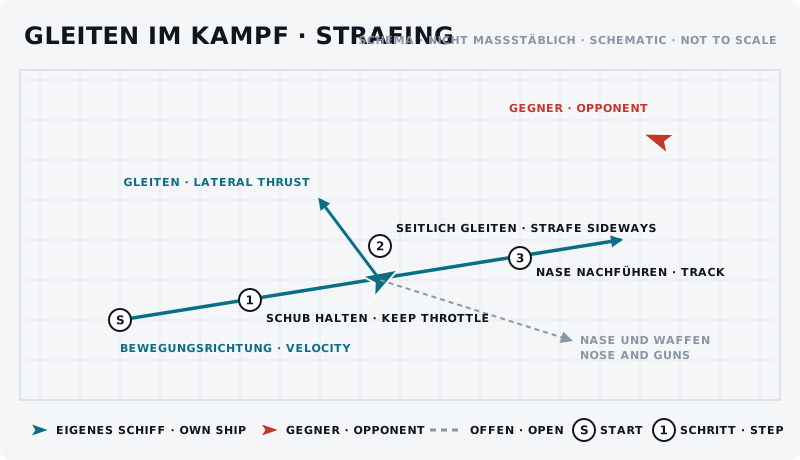
The sketch shows the manoeuvre from above: own ship blue, opponent red, start marked “S”, steps numbered.
What should the opponent see?
He sees a ship whose nose and path do not match. That makes his lead difficult – and at the same time tells him you know what you are doing.
Typical mistakes
- Strafing instead of turning. Strafing does not replace a turn; it complements it.
- Continuous strafing. A new straight line is no improvement.
- Taking the nose along. Swinging the nose while strafing gains you nothing.
- Too much at once. First hold the nose, then one strafe direction, then throttle – learn it in that order.
Opponent’s counter
He closes in, because lateral movement matters less at short range, or he switches to fixed guns and aims by hand.
Exercise
- Goal
- Strafe around a stationary partner without taking your nose off him.
- Preparation
- A partner holds still. Open space, no time pressure.
- Task
- Keep your nose on him and fly a square around him using only the strafe directions: up, right, down, left. Then the same diagonally. Finally combined with forward throttle.
- Success criterion
- The partner stays in your reticle throughout the whole square.
- Partner
- required
- Functions needed
- Strafe left / right (abs.)
- Strafe up / down (abs.)
- Throttle - Forward / Back
- Strafe up (abs.)
- Strafe down (abs.)
- Strafe left (abs.)
Beginner variant
Practise the square around a stationary partner. Nothing else. That is the basis for everything that follows.
Advanced variant
Strafing in a turning fight: hold an orbit and change the strafe direction twice without losing the circle.
Next step
To separate nose and path completely, fly decoupled. To make shots run into nothing with it: pip manipulation.